Deploying mismatched attachments creates severe operational risks. Equipment faces tipping hazards, accelerated structural wear, and catastrophic hydraulic system failures when operators ignore basic physics. Selecting a Hydraulic Grapple is a strict mathematical calculation. Choosing the wrong size directly compromises the machine's Rated Operating Capacity (ROC). It reduces breakout force and creates unsafe lifting dynamics across excavators, skid steers, and compact track loaders.
Operators must match attachment geometry and weight to the specific capabilities of their carrier. We outline a technical framework for specifying the correct attachment. You must align carrier machine specifications—including operating weight, ROC, auxiliary hydraulic flow, and front loader width—with material density and specific application requirements. This approach ensures stable lifting, precise load control, and long-term equipment reliability.
Payload Economics: The physical weight of the grapple directly subtracts from the machine’s usable lifting capacity; heavier attachments require sacrificing payload to maintain stability.
Hydraulic Synchronization: Auxiliary hydraulic flow (GPM) and pressure (PSI) must precisely match the grapple’s cylinder specifications to prevent sluggish operation, fluid overheating, or seal blowouts.
Application-Specific Geometry: Selecting between an orange peel grapple, clamshell, or grab fork depends entirely on material shape, density, and required retention rates.
Width Optimization: Grapple width should align with or slightly exceed the carrier’s outer tire or track width to protect the machine while optimizing the volume of material moved per pass.
Center of Gravity Management: Safe working limits must account for the combined weight of the attachment and the maximum anticipated load at full boom extension or height.
The Physics of Stable Lifting: Why Sizing Matters
Rated Operating Capacity (ROC) and Payload Limits
Rated Operating Capacity dictates the maximum load a machine can safely handle without risking a tip-over. The mathematical relationship between attachment weight and maximum allowable payload is absolute. Every pound of steel in the grapple subtracts directly from the machine's available lifting capacity. If a skid steer has an ROC of 2,500 pounds and the grapple weighs 1,000 pounds, the maximum safe payload is strictly limited to 1,500 pounds. Operators on site often forget this subtraction, leading to dangerous overloading scenarios.
The tipping load threshold shifts dramatically during operation. When a fully loaded grapple extends outward or upward, the center of gravity moves further from the machine's pivot point. This leverage effect multiplies the downward force on the front axle. Tipping dynamics vary significantly between machine types. A 360-degree rotating excavator platform must maintain stability across its entire swing radius, relying heavily on counterweights. Conversely, a fixed-direction front-end loader like a tractor or compact track loader faces primary tipping risks along a single forward axis.
ROC Calculation Example | Machine Type | Base ROC (lbs) | Grapple Weight (lbs) | Usable Payload (lbs) | Max Boom Extension Risk |
| Compact Track Loader | 3,200 | 950 | 2,250 | High forward tipping risk |
| Mid-Size Excavator | 8,500 | 2,100 | 6,400 | Lateral swing tipping risk |
| Utility Tractor | 1,800 | 600 | 1,200 | Front axle overload |
Hydraulic System Compatibility
The correlation between the carrier machine’s auxiliary flow, measured in gallons per minute (GPM), and the grapple’s cylinder actuation speed is critical. Supplying too little flow results in sluggish jaw movement, severely impacting cycle times. Supplying too much flow forces hydraulic fluid through narrow cylinder ports too quickly, generating excessive heat and risking pump damage. Field mechanics frequently see burnt hydraulic fluid caused by mismatched flow rates.
Pressure ratings, measured in pounds per square inch (PSI), dictate the actual gripping force of the attachment. Over-pressurizing the system leads to catastrophic cylinder failure, blown seals, and ruptured hoses. Under-pressurizing results in weak clamping force, causing dangerous load slippage during transit. Tractors and compact loaders often require third-function valves to supply consistent, independent hydraulic power to the attachment. These valves allow operators to open and close the jaws without interrupting the primary boom and bucket tilt functions.
Identify the carrier machine's maximum auxiliary GPM and PSI from the OEM manual.
Compare these figures against the grapple cylinder's rated maximums.
Install flow restrictors if the carrier output exceeds the attachment rating.
Test jaw actuation speed at low idle before operating at full throttle.
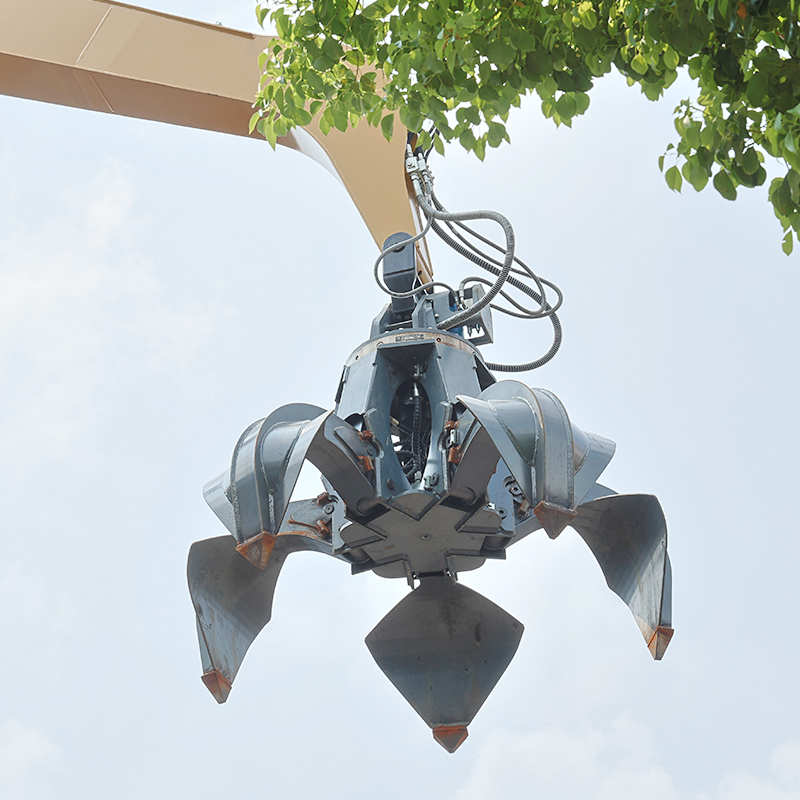
Categorizing Hydraulic Grapples by Application
Excavator Hydraulic Grapple Configurations
Heavy-duty demolition and scrap sorting demand specific tine configurations. A two-tine versus three-tine setup offers different advantages depending on the debris. Two tines provide better penetration into dense, tangled piles of rebar or concrete. Three tines offer superior stabilization for bulky, asymmetrical objects. Selecting an excavator hydraulic grapple requires evaluating structural trade-offs. Rigid, stiff-arm grapples are lighter and mechanically simpler, relying on the bucket cylinder for actuation. Rotating grapples offer 360-degree load positioning flexibility but add significant weight and maintenance complexity due to the hydraulic rotary manifold.
Orange Peel Grapple Applications
Scrap yards, bulk recycling facilities, and waste management operations handle highly irregular materials. An orange peel grapple is engineered specifically for these environments. The multi-tine design envelops loose scrap, preventing spillage during rapid loading cycles. Tine count directly impacts performance. A 4-tine configuration offers higher penetration force per tine, making it ideal for compacted scrap. A 5-tine setup improves material retention for smaller, looser debris but increases the total hydraulic demand and overall attachment weight.
Grab Fork for Material Handling
Forestry, log sorting, and pipe handling require specialized clamp geometry. A grab fork for material handling features wide, curved jaws designed to wrap around cylindrical or elongated materials. Load stabilization is the primary requirement here. The upper clamp must apply continuous downward pressure against the lower forks to prevent logs or pipes from shifting laterally during transport. The spacing between the bottom forks must support the load evenly without allowing shorter pieces to fall through.
Hydraulic Clamshell Bucket Uses
Deep excavation, vertical shaft digging, and loose aggregate handling require vertical penetration. A hydraulic clamshell bucket utilizes two hinged buckets that close together to scoop material. Operators must calculate volumetric capacity against material density to prevent overloading the carrier boom. Wet sand or saturated mud weighs significantly more per cubic yard than dry topsoil. Failing to account for this density variance will cause the excavator to exceed its safe working radius, leading to immediate tipping hazards or long-term structural fatigue.
Grapple Type Application Matrix | Grapple Type | Primary Material | Key Advantage | Limitation |
| Excavator Grapple | Demolition debris, concrete | High breakout force | Poor retention of fine materials |
| Orange Peel | Scrap metal, municipal waste | Maximum irregular load retention | High weight, complex hydraulics |
| Grab Fork | Logs, pipes, brush | Cylindrical load stabilization | Cannot handle loose aggregate |
| Clamshell Bucket | Sand, gravel, mud | Vertical digging, zero spillage | No clamping force for large debris |
Technical Evaluation Dimensions for Grapple Selection
Machine-to-Attachment Weight Ratios
Calculating the maximum allowable attachment weight requires consulting the carrier's load charts. Compact tractors, skid steers, compact track loaders, and excavators all possess distinct lifting thresholds. A general engineering guideline suggests the attachment should not consume more than 30 to 40 percent of the machine's total ROC. Carrier wheelbase, track width, and factory counterweights heavily influence stability. Lifting heavy, asymmetrical loads with a lightweight carrier on a narrow wheelbase drastically increases the risk of lateral rollover, especially on uneven terrain.
Grapple Width vs. Carrier Footprint
Matching the grapple width to the outer width of the carrier's tires or tracks is a critical operational requirement. The attachment must clear a path for the machine to drive into a material pile without the tires snagging on debris. However, wider is not always better. Smaller machines with lower ROC values perform best with narrower, lighter grapples. A narrow profile preserves essential lifting capacity and concentrates the machine's pushing force into a smaller surface area, improving pile penetration.
Kinematics and Jaw Opening Width
Matching the maximum jaw opening to the largest expected debris, log, or boulder size ensures operational efficiency. If the jaws cannot open wide enough to bite the target material, the operator must awkwardly balance the load, risking drops. Conversely, the minimum closing diameter is equally important. If the jaws do not bypass each other or close tightly enough, small, loose, or thin materials will slip through the gap during transit.
Material Durability and Wear Parts
High-wear zones like tine tips, cutting edges, and wear plates require high-yield steel grades. Materials like AR400 and AR500 steel resist abrasion and impact far better than standard mild steel. Long-term maintenance costs hinge on wear part configurations. Replaceable bolt-on edges allow for rapid field swaps, minimizing downtime. Weld-on wear parts require grinding, welding, and shop time, but they offer a stronger, seamless profile for aggressive digging applications.
Trade-Offs and Overall Value Influencing Factors
Volumetric Capacity and Trip Optimization
Selecting a larger grapple capacity reduces the number of trips required to clear a site. However, this productivity trade-off increases the risk of carrier strain, rapid cycle-fatigue, and tipping. Pushing a machine to its absolute limit on every pass accelerates pin wear and degrades hydraulic pump seals. Operators must establish an ideal sweet spot. Balancing cycle speed with moderate grapple volume maximizes daily material throughput without compromising equipment health.
Hydraulic vs. Mechanical Grapples
Hydraulic models require a higher upfront capital expenditure and involve complex installation, including routing auxiliary lines and installing third-function valves. However, they provide unmatched operational efficiency and precision load control. Operators can independently clamp down on uneven loads. Mechanical grapples depend entirely on the bucket cylinder movement. They lack the ability to make dynamic, independent load adjustments, limiting their effectiveness in complex sorting applications.
Width vs. Penetration Force
Wider grapples cover more surface area, allowing operators to clean up loose brush or debris quickly. This width distributes the machine's pushing force and clamping pressure over more tines, significantly reducing penetration capability in dense or compacted piles. Narrow grapples offer higher breakout and clamping force per square inch. They excel at digging out stumps or ripping through compacted scrap, but they require more operational passes to relocate bulk material.
Implementation Risks and Mitigation Strategies
Hydraulic Mismatch and Overheating
Supplying excessive hydraulic flow to an attachment causes fluid overheating, cavitation, and premature pump wear. The hydraulic oil shears as it forces its way through undersized cylinder ports, rapidly degrading its viscosity. To mitigate this risk, operators must strictly match carrier specifications to attachment requirements. Installing flow restrictors or utilizing machine-side adjustable flow control settings ensures the attachment receives the precise GPM required for safe, sustained operation.
Structural Fatigue and Overloading
Operator error in lifting beyond the combined ROC leads to severe mechanical failures. Boom stress fractures, cylinder bending, and machine tipping are common consequences of ignoring load charts. Mitigation requires strict operational discipline. Implementing onboard load-weighing systems provides real-time feedback to the cab. Utilizing pressure relief valves prevents the cylinders from absorbing fatal shock loads. Enforcing strict operator training protocols regarding load limits is non-negotiable for site safety.
Conclusion
Consult your carrier machine’s OEM manual to document exact auxiliary hydraulic flow (GPM) and pressure (PSI) limits before purchasing any attachment.
Calculate the average density of your primary materials to establish a baseline payload weight per cycle, ensuring it falls within your machine's ROC.
Measure the outer track or tire width of your machine to determine the minimum required grapple width for safe path clearing.
Request operational demonstration data and cylinder specifications from attachment manufacturers to verify compatibility and prevent hydraulic mismatch.
FAQ
Q: How do I match an excavator hydraulic grapple to my machine's hydraulic flow (GPM)?
A: Check the excavator’s OEM manual for the auxiliary hydraulic circuit's maximum GPM. Compare this figure against the grapple manufacturer's required flow range. If the machine's output is too high, you must adjust the carrier's flow settings or install a flow restrictor to prevent cylinder seal damage and fluid overheating.
Q: Should a hydraulic grapple be wider than the tracks or tires of my skid steer or tractor?
A: Yes, the grapple should generally be equal to or slightly wider than the outer footprint of the tires or tracks. This ensures the attachment clears a path for the machine, preventing the tires from driving over sharp debris or snagging on the material pile during loading.
Q: What is the functional difference between an orange peel grapple and a hydraulic clamshell bucket?
A: An orange peel grapple uses multiple independent tines to wrap around and retain irregular, bulky scrap metal or waste. A hydraulic clamshell bucket uses two solid, hinged shells designed to scoop and retain loose, fine materials like dirt, gravel, or dredged mud without spillage.
Q: How does the physical weight of the grapple affect my machine's Rated Operating Capacity (ROC)?
A: The physical weight of the grapple is dead weight that directly subtracts from the machine's ROC. If your machine has a 3,000-pound ROC and the grapple weighs 1,200 pounds, your maximum safe material payload is reduced to exactly 1,800 pounds.
Q: Can I use a grab fork for material handling on loose scrap or fine aggregate?
A: No. Grab forks feature wide spacing between the tines and are engineered specifically for long, cylindrical loads like logs, pipes, or large brush. Loose scrap or fine aggregate will easily fall through the gaps, requiring a solid bucket or a tightly spaced multi-tine grapple instead.
Q: What happens if my carrier machine's PSI exceeds the grapple's maximum pressure rating?
A: Exceeding the grapple's maximum PSI rating will over-pressurize the attachment's hydraulic cylinders. This causes immediate and catastrophic failures, including blown cylinder seals, ruptured hydraulic hoses, or physically bent cylinder rods due to excessive clamping force.
Q: How do I determine the correct jaw opening width and minimum closing diameter for my application?
A: Measure the largest single piece of material you expect to handle; the maximum jaw opening must exceed this dimension. Measure the smallest debris you need to retain; the minimum closing diameter must be smaller than this material to prevent it from slipping through fully closed jaws.

 English
 العربية
 Français
 Русский
 Español
 Português
 Deutsch
 italiano
 日本語
日本語 한국어
한국어 Nederlands
 Tiếng Việt
 ไทย
ไทย Polski
 Türkçe
 አማርኛ
አማርኛ ພາສາລາວ
 ភាសាខ្មែរ
 Bahasa Melayu
 ဗမာစာ
ဗမာစာ தமிழ்
தமிழ் Filipino
 Bahasa Indonesia
 magyar
 Română
 Čeština
 Монгол
 қазақ
қазақ Српски
 हिन्दी
 فارسی
فارسی Kiswahili
 Slovenčina
 Slovenščina
 Norsk
Norsk Svenska
 українська
 Ελληνικά
 Suomi
Suomi Հայերեն
 עברית
עברית Latine
 Dansk
Dansk اردو
اردو Shqip
Shqip বাংলা
বাংলা Hrvatski
 Afrikaans
 Gaeilge
 Eesti keel
 Māori
Māori


