High-volume log yards operate on tight margins where profitability hinges on cycle times, load stability, and minimizing equipment downtime. Moving timber efficiently demands more than raw machine power; it requires the exact right attachment for the specific material profile. Mismatched attachments introduce severe hidden costs. You will see premature hydraulic failure, dropped loads, structural fatigue, and highly inefficient sorting of mixed-diameter timber. When a carrier struggles to secure a load, operators waste fuel and time repositioning, while the risk of equipment damage escalates rapidly.
Evaluating a Forestry Grapple requires looking beyond the initial purchase price. Operations must strictly assess carrier compatibility, jaw architecture, and specific material handling requirements. A well-matched attachment streamlines truck unloading, mill feeding, and decking tasks. This guide breaks down the technical criteria for selecting the optimal log handling attachment to maximize yard efficiency and safeguard machinery.
Architecture Dictates Function: Bypass grapples excel at sorting mixed-diameter logs, while non-bypass designs offer superior clamping force for uniform, heavy timber.
Carrier Compatibility is Non-Negotiable: A grapple’s weight and hydraulic requirements must strictly align with the carrier machine (skid steer, wheel loader, or excavator) to prevent tipping risks and hydraulic overheating.
Durability Equals ROI: High-tensile steel (e.g., AR400/Hardox) and shielded hydraulic cylinders are mandatory for surviving the abrasive, high-impact environment of a commercial log yard.
Rotators Drive Efficiency: Continuous rotation capabilities drastically reduce carrier repositioning, saving fuel and reducing undercarriage wear in tight yard layouts.
Installation & Terrain Safety: Proper initial hydraulic commissioning prevents system contamination, while specialized operator protocols for slope and trail navigation protect machinery and personnel from rollover hazards.
Defining Success Criteria for Log Handling Operations
Throughput vs. Precision
Establishing baseline operational goals dictates attachment selection. High-volume bulk moving prioritizes wide jaw openings and rapid cycle times to clear trucks and feed mills quickly. You need attachments that grab massive bundles in a single pass. Conversely, precise sorting and decking require attachments that offer fine control over individual stems. Operations must evaluate whether their primary bottleneck is bulk volume transfer or the meticulous sorting of different wood grades.
| Operational Goal | Primary Requirement | Ideal Attachment Feature | Common Application |
| High-Volume Bulk Moving | Maximum payload per cycle | Wide jaw opening, high capacity | Unloading logging trucks, feeding chippers |
| Precise Sorting | Individual stem control | Overlapping bypass jaws, continuous rotation | Sorting sawlogs from pulpwood, decking |
| Mixed Debris Handling | Material retention | Multi-claw design, tight closing gap | Clearing logging residues, brushwood |
Yard managers must track cycle times to determine where the delays occur. If trucks wait too long to be unloaded, bulk capacity is the priority. If the mill feed is inconsistent due to poorly sorted decks, precision handling takes precedence.
Material Variability
The average diameter, length, and weight of the timber determine the required opening width and clamping force of a log handling grapple. Handling massive, uniform sawlogs requires high tip pressure to secure the load. Processing mixed-diameter pulpwood or varied stems demands an attachment capable of wrapping tightly around uneven bundles without crushing the smaller logs inside the grasp.
When dealing with hardwood versus softwood, the density changes the weight dynamics significantly. A bundle of green oak weighs substantially more than a similarly sized bundle of dry pine. Operators must size the attachment based on the heaviest, densest material they expect to handle regularly, not just the average load.
Site and Terrain Constraints
Yard layout, terrain, and aisle width heavily influence the choice between a rigid attachment and a rotating grapple. Flat concrete yards with wide aisles accommodate rigid setups easily. In contrast, tight decking areas or uneven forest trails require continuous rotation to align logs without constantly repositioning the carrier machine. The physical environment directly impacts how nimble the attachment needs to be.
Consider the undercarriage wear on tracked machines. Constantly pivoting a skid steer or excavator to align a rigid grapple tears up the ground and accelerates track wear. A rotating attachment absorbs that alignment duty, saving the carrier's undercarriage and reducing ground disturbance.
Slope and Trail Dynamics
Negotiating uneven forest floors and steep gradients affects machine stability when holding high-tonnage logs. A heavy attachment extending far from the carrier alters the center of gravity. Operators must account for slope dynamics to prevent rollover hazards, ensuring the combined weight of the machine, attachment, and timber remains stable during transit.
Always travel straight up or down a slope, never across the face of the gradient.
Keep the load positioned as low to the ground as physically possible during transit.
When traveling uphill, keep the heavy load facing forward to maintain traction on the front axle or idlers.
When traveling downhill, reverse the machine so the load remains pointed up the slope.
Avoid sudden braking or jerky steering inputs that can induce dynamic load swings.
Forestry Grapple Architectures and Solution Categories
Bypass vs. Non-Bypass Designs
Bypass grapples feature an overlapping jaw design. This architecture allows the jaws to close tightly past one another, securing multiple logs or stems of varying diameters. It is the industry standard for mixed sorting, as it prevents smaller logs from slipping out of the bundle. The overlapping tines create a tight, secure basket that adapts to the shape of the load.
Non-bypass, or fixed grapples, utilize a tip-to-tip jaw closure. This design delivers maximum tip pressure, making it ideal for handling single, large-diameter logs where precise placement and unyielding grip are required. Because the jaws meet exactly in the middle, they cannot close tighter than their minimum gap, making them unsuitable for small, loose brush or highly variable bundles.
Specialized Grab Forks and Tongs
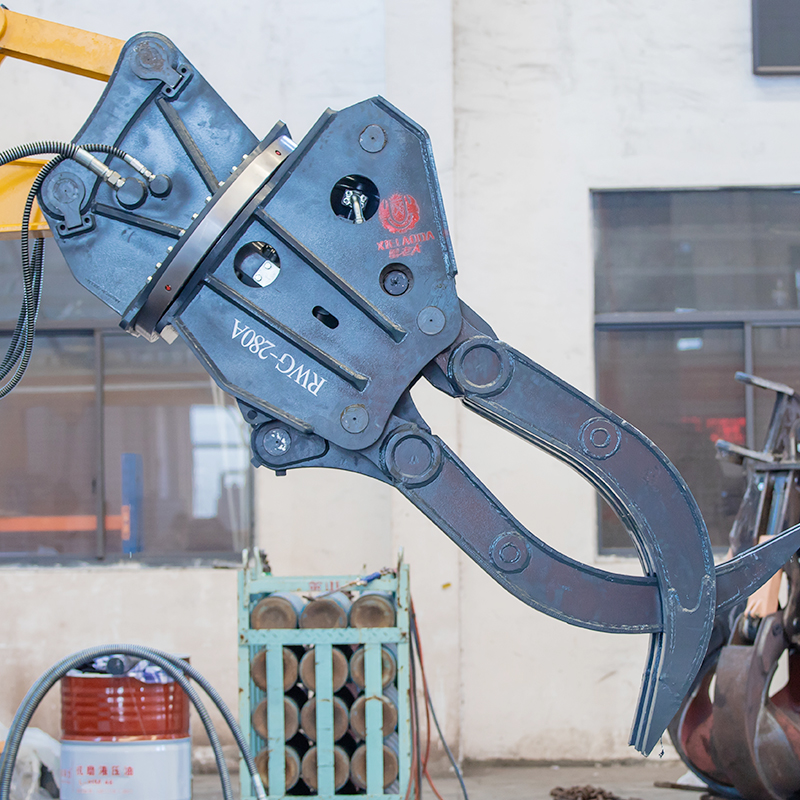
A forestry grab fork typically features a heavy-duty profile with twin-arm claw clamping, often mounted on wheel loaders. This configuration excels at unloading trucks and feeding mills through high-capacity scooping actions. The lower tines slide under the log deck, while the upper claws clamp down to secure massive payloads.
Multi-claw, or polyp tongs, differ significantly from standard forks. They feature multiple independent tines designed to grasp loose brushwood, logging residues, and irregular limbs, rather than clean, mill-ready timber. The independent movement of the claws allows them to conform to highly irregular shapes, ensuring a tight grip on loose debris.
Comparing root grapples to dedicated log handling attachments reveals distinct operational focuses. Root grapples utilize open-bottom tines built for land clearing, stump pulling, and dragging debris through dirt. Dedicated log grapples feature specialized, smooth-jawed geometries designed specifically to protect log grade and bark integrity during sorting and stacking. Using a root grapple for mill-quality logs often results in deep gouges and damaged bark, reducing the timber's value.
Frame Geometry: Open-Bottom vs. Solid-Bucket Designs
Open-bottom grapples utilize an open framework that sheds dirt, rocks, and debris during transport. This self-cleaning action preserves mill machinery by keeping abrasive contaminants out of the chippers and saws. When operators pick up a load of logs from a muddy yard, the loose dirt falls through the tines before the logs reach the processing equipment.
Solid or bucket-bottom grapples offer high-capacity utility for dual-purpose operations. They handle fine bark debris, wood chips, and soil cleanup effectively, though they lack the debris-shedding capability of open-frame designs. Yards that need to scoop up piles of loose bark or load wood chips into trucks often rely on solid-bottom designs to prevent material loss during transit.
Carrier Compatibility and Hydraulic Integration
Matching Attachment Weight to Carrier Capacity
Skid steers and compact track loaders require strict adherence to tipping load calculations. Over-sizing the grapple reduces the actual payload capacity and destabilizes the machine on uneven terrain. If a skid steer has a rated operating capacity of 3,000 pounds, and the grapple weighs 1,200 pounds, the operator can only safely lift 1,800 pounds of timber. Pushing beyond this limit causes the rear wheels to lift, creating a severe safety hazard.
Excavators and wheel loaders handling heavy-duty wood handling grab fork attachments demand robust structural requirements. Operators must evaluate pin-on versus quick-coupler systems. Pin-on setups offer a tighter, more rigid connection with less play, ideal for heavy torsional loads. Quick-couplers provide versatility for yards that frequently switch between buckets and grapples, but they add weight and extend the load center further from the machine pins.
Hydraulic Flow and Pressure Requirements
Matching the grapple’s cylinder and rotator requirements with the carrier’s auxiliary hydraulic output dictates performance. Operators must verify the Gallons Per Minute (GPM) and Pounds per Square Inch (PSI) specifications. Mismatched hydraulic flow risks fluid overheating and accelerates wear on the carrier’s hydraulic pump, leading to sluggish operation and eventual system failure.
| Hydraulic Issue | Symptom | Potential Cause | Corrective Action |
| Low GPM | Sluggish jaw movement, slow rotation | Carrier pump undersized, restricted lines | Verify carrier flow matches attachment specs |
| Excessive GPM | Jerky movements, rapid overheating | Flow rate exceeds rotator/cylinder capacity | Install flow restrictors or adjust carrier settings |
| Low PSI | Weak clamping force, dropped logs | Relief valve set too low, worn pump | Calibrate pressure relief valves to spec |
| Overheating | Hot hydraulic lines, fading power | Continuous flow over relief, mismatched specs | Check for line restrictions, verify GPM match |
If a continuous rotator requires 10 GPM but the carrier pushes 25 GPM, the excess fluid forces its way through the relief valve, generating massive amounts of heat. This heat breaks down hydraulic fluid viscosity, destroying seals and pumps across the entire machine.
Installation and Commissioning Best Practices
Proper installation begins with hydraulic purging. Flushing the carrier's and attachment's hydraulic circuits before the first-time connection prevents contaminant introduction. Even microscopic metal shavings left over from manufacturing can score cylinder walls and destroy valve blocks.
Verifying and calibrating the carrier's pressure relief valves to match the grapple's maximum operating PSI prevents cylinder seal blowout. If the grapple cylinders are rated for 3,000 PSI and the excavator pushes 4,500 PSI, the seals will rupture under heavy load. Mechanics must use inline pressure gauges to set the auxiliary circuit relief valves precisely before the attachment ever touches a log.
Evaluating Build Quality
Structural Integrity and Metallurgy
The abrasive nature of log handling demands high-yield steel construction. Utilizing abrasion-resistant grades like Hardox 450 or AR400 in the tines and main frame prevents bending under severe torsional loads. Standard mild steel will deform quickly when operators twist a heavy log out of a frozen pile. High-tensile steel flexes and returns to its original shape, absorbing the shock loads inherent in forestry work.
Critical stress points, including pivot pins and jaw curves, require heavy gusseting to withstand the repeated impacts of loading and unloading heavy timber. Look for reinforced box-section construction in the main frame rather than simple flat plating. The pivot points should feature oversized, hardened steel pins running in replaceable bronze or composite bushings.
Component Protection
Hydraulic cylinders must be fully enclosed or heavily guarded to prevent damage from rogue branches and shifting logs. Exposed cylinders are highly vulnerable in forestry applications. A single stray limb can dent a cylinder rod or tear off a hydraulic fitting, instantly disabling the machine and causing a massive fluid spill.
Internal hose routing and heavy-duty protective sleeving minimize snagging and burst risks during aggressive log handling. Hoses should run through the center of the rotator and inside the structural tubing of the grapple frame whenever possible. Any exposed hose sections require spiral wrap or ballistic nylon sleeving to resist abrasion against rough bark and sharp branches.
Rotator Mechanisms
Fixed grapples limit maneuverability. Continuous hydraulic rotators provide long-term cycle-time reductions by allowing operators to align logs precisely without moving the carrier. Heavy-duty rotators withstand axial and radial loads, drastically improving efficiency in tight decking yards.
When selecting a rotator, evaluate the bearing design. High-capacity slew ring rotators handle the extreme side-loads generated when operators use the grapple to sweep logs across the ground or push timber into a pile. Lighter-duty vane rotators work well for free-hanging applications but will fail quickly if subjected to heavy side-loading.
Implementation Risks and Mitigation Strategies
Operator Safety and Training
Carrying heavy, shifting loads alters machine physics. Operators must keep loads low to the ground and centered, especially when navigating slopes, negotiating forest trails, or turning tight yard corners. Rapid deceleration causes dynamic load swings, particularly with free-hanging rotating attachments. If an operator stops an excavator swing abruptly, the momentum of the logs continues, potentially tipping the machine or damaging the boom.
Bulky grapple frames obscure the operator's line of sight. Mitigating this requires proper attachment selection, cab-forward designs, and auxiliary camera systems. Operators must learn to rely on spotters in tight yards and use camera feeds to verify the area is clear before swinging a loaded grapple.
Maintenance Protocols
A realistic daily maintenance checklist prevents catastrophic failures. Operators should grease pivot pins, inspect hydraulic fittings for weeping, and check for hairline fractures in high-stress zones daily. Monitoring and replacing wear parts, such as bushings, wear strips, and pins, protects the main grapple housing from irreversible damage.
Grease all pivot points and rotator bearings at the start of every shift to flush out dirt and moisture.
Visually inspect all hydraulic hoses for chafing, cuts, or weeping fittings.
Check the torque on all mounting bolts and rotator flange bolts weekly.
Inspect the jaw tips and cutting edges for excessive wear or cracking.
Verify the cylinder rods are free of dents, scratches, or hydraulic fluid film indicating a failing seal.
Ignoring minor wear leads to major structural failure. If a pivot pin bushing wears completely through, the steel pin begins grinding directly against the grapple frame. This ovalizes the mounting hole, requiring expensive line-boring and welding to repair, keeping the attachment out of service for days.
Conclusion
Audit your current carrier’s auxiliary hydraulic specifications, verifying exact GPM and PSI outputs before selecting an attachment.
Select bypass grapples for mixed-diameter sorting or grab forks for high-volume bulk loading based on your specific yard throughput needs.
Consult with a specialized attachment dealer to arrange a site-specific demonstration to test carrier stability and hydraulic performance.
Implement strict daily maintenance checklists focusing on cylinder guards, pivot pin greasing, and hydraulic hose routing inspections.
FAQ
Q: What is the difference between a bypass and non-bypass forestry grapple?
A: A bypass grapple features overlapping jaws that close tightly past each other, making it ideal for securing mixed-diameter logs without dropping smaller stems. A non-bypass grapple uses a tip-to-tip closure, providing maximum clamping force for handling single, large-diameter logs with precise control.
Q: How much hydraulic flow is required for a log handling grapple?
A: Hydraulic flow requirements vary based on cylinder size and the presence of a rotator. Attachments typically require a specific GPM range. Mismatched flow can cause sluggish operation, weak clamping force, or severe hydraulic fluid overheating.
Q: Can I use a forestry grab fork on a standard skid steer?
A: Yes, but you must strictly adhere to the skid steer's tipping load capacity. The combined weight of the heavy-duty fork and the timber must not exceed safe operating limits, and the machine must have the appropriate auxiliary hydraulics to run the attachment.
Q: What is the difference between a root grapple and a log handling grapple?
A: Root grapples feature open tines designed for tearing roots and dragging debris through dirt. Log handling grapples utilize smooth-jawed geometries designed specifically for clean, non-destructive sorting and stacking of merchantable timber to protect log grade.
Q: How do I safely navigate steep slopes and forest trails with a loaded forestry grapple?
A: Keep the load as low to the ground as possible to maintain a low center of gravity. Align the machine straight up or down the hill gradient, avoid sudden turns, and move slowly to prevent dynamic load swings and rollover hazards.
Q: What is the advantage of a continuous rotator on a wood handling grab fork?
A: A continuous rotator allows the operator to spin and align logs precisely without repositioning the carrier machine. This reduces undercarriage wear, saves fuel, and significantly speeds up truck loading and unloading times in tight yards.

 English
 العربية
 Français
 Русский
 Español
 Português
 Deutsch
 italiano
 日本語
日本語 한국어
한국어 Nederlands
 Tiếng Việt
 ไทย
ไทย Polski
 Türkçe
 አማርኛ
አማርኛ ພາສາລາວ
 ភាសាខ្មែរ
 Bahasa Melayu
 ဗမာစာ
ဗမာစာ தமிழ்
தமிழ் Filipino
 Bahasa Indonesia
 magyar
 Română
 Čeština
 Монгол
 қазақ
қазақ Српски
 हिन्दी
 فارسی
فارسی Kiswahili
 Slovenčina
 Slovenščina
 Norsk
Norsk Svenska
 українська
 Ελληνικά
 Suomi
Suomi Հայերեն
 עברית
עברית Latine
 Dansk
Dansk اردو
اردو Shqip
Shqip বাংলা
বাংলা Hrvatski
 Afrikaans
 Gaeilge
 Eesti keel
 Māori
Māori


