An excavator’s profitability relies heavily on its daily utilization rates. Overall attachment versatility also plays a major role in fleet efficiency. Relying solely on standard buckets limits your site capabilities. Basic thumbs also struggle during complex material handling tasks. Upgrading to specialized attachments requires initial capital expenditure. It also demands specific hydraulic system modifications on your existing machines. Fleet managers must constantly justify this upfront cost against actual projected productivity gains.
In this guide, we evaluate the distinct operational advantages of an excavator hydraulic grapple. You will see how it compares directly against traditional mechanical alternatives. We analyze the specific features that drive on-site performance and safety. Finally, we provide a structured framework to help you shortlist the correct attachment for specific industrial applications.
Key Takeaways
Precision and Retention: Hydraulic grapples offer continuous 360-degree rotation and consistent clamping force, outperforming rigid mechanical grab arms in load security and cycle speeds.
Application Specificity: ROI depends on matching the grapple type (demolition, scrap, forestry) to the primary material handled and the carrier machine's operating weight.
Implementation Prerequisites: Successful adoption requires verifying the carrier's hydraulic flow rates (GPM), operating pressure, and the presence of multi-functioning auxiliary plumbing.
Overcoming Site Inefficiencies: Mechanical Grabs vs. Hydraulic Grapples
Operators face severe operational limitations when using basic mechanical thumbs. These simple grab arms feature limited structural articulation. They rely almost entirely on the bucket curling motion to secure a grip. You cannot rotate the attachment independently without repositioning the entire carrier machine. This constant track movement damages delicate ground surfaces. It also accelerates costly undercarriage wear over time.
Advanced hydraulic attachments solve these specific mobility and control problems. Independent cylinder control provides dynamic, adjustable clamping pressure. You can secure irregular loads firmly without crushing them. This precise control drastically reduces dropped materials on busy sites. It also improves overall site safety in tight operational envelopes. Ground workers face fewer overhead hazards. Operators maneuver heavy, awkward debris smoothly and predictably.
Many contractors focus strictly on initial equipment expenses. A mechanical grab arm costs significantly less upfront. It also requires minimal daily maintenance routines. However, this basic setup severely slows down high-frequency sorting tasks. A hydraulic upgrade significantly reduces your daily cycle times. Fast loading requires continuous rotation and active, independent clamping power. In high-volume environments, a mechanical option simply cannot keep pace with production demands. Upgrading becomes necessary to prevent operational bottlenecks.
Performance Comparison Chart | Feature Category | Mechanical Grab Arm | Advanced Hydraulic Model |
| Articulation | Limited to bucket curl range | Independent jaw movement |
| Rotation | Requires moving the machine | 360-degree continuous rotation |
| Clamping Force | Static; depends on bucket position | Dynamic; controlled by cylinders |
| Cycle Speed | Slow; requires frequent repositioning | Fast; aligns quickly with materials |
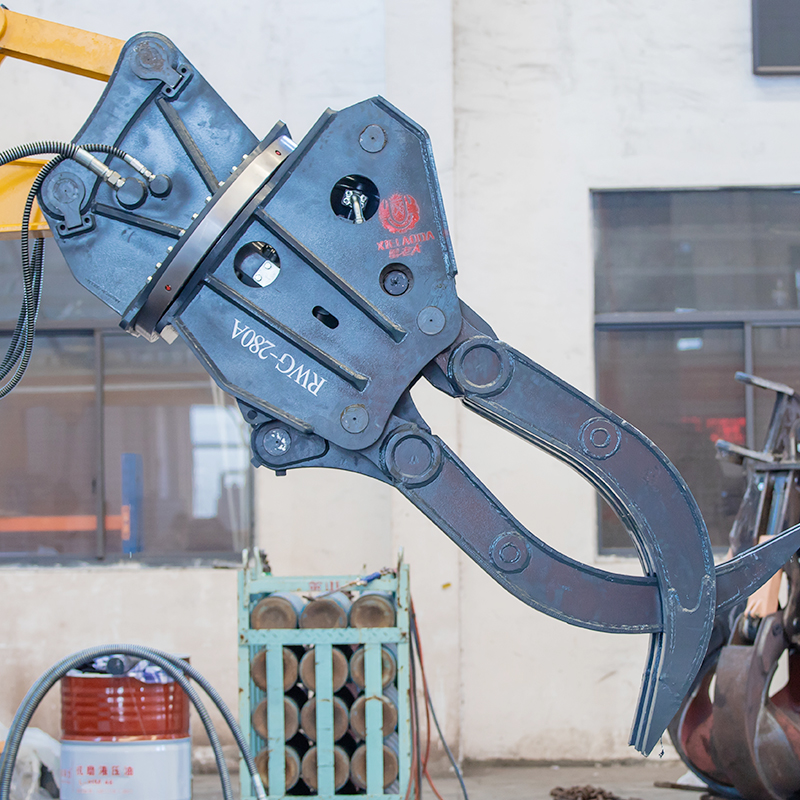
Aligning Grapple Categories with Heavy-Duty Applications
You must match the attachment perfectly to your primary material. Different industrial sectors require highly specialized jaw designs. Selecting the wrong profile leads to inefficient handling and premature equipment wear.
Demolition and Sorting Grapples
These rugged models handle brutal urban teardown environments.
Design: They feature perforated or heavily ribbed jaws. This open structure ensures high visibility for the machine operator. It also allows dirt, dust, and fine debris to sift through easily. Flat edges help grip structural materials and concrete slabs securely.
Outcome: You achieve highly efficient separation of rebar, concrete, and timber. You perform this sorting directly on the active demolition site. This immediate material separation reduces expensive waste transport costs significantly.
Scrap and Recycling (Orange Peel) Grapples
Scrap yards deal constantly with loose, unpredictable, and jagged materials.
Design: These specialized units utilize complex multi-tine configurations. They typically feature four to five independent tines. Each individual tine operates on its own dedicated hydraulic cylinder for adaptable gripping.
Outcome: You gain maximum volume retention per cycle. The independent tines wrap organically around irregular, loose materials. They excel at moving tangled scrap metal, white goods, and municipal solid waste efficiently.
Forestry and Log Grapples
Commercial logging requires the careful, rapid handling of heavy timber.
Design: These robust tools feature specialized interlocking bypass jaws. The jaws cross over one another during closure. This allows a remarkably tight closure around varying log diameters.
Outcome: You ensure secure stacking and rapid loading of harvested timber. The smooth, curved design prevents accidental damage to the valuable wood product. Utilizing a dedicated Hydraulic Grapple streamlines your entire lumber yard operation.
Core Evaluation Dimensions: Features to Operational Outcomes
You need to evaluate several critical technical features before making a purchase. These hidden specifications directly impact your daily operational outcomes and long-term reliability.
Rotational Capabilities: You must choose carefully between fixed and 360-degree continuous rotation. Continuous rotation minimizes costly track wear. It allows the attachment to align seamlessly with the target material. You avoid moving the whole heavy machine just to grab a single awkward item.
Cylinder Protection and Power: Safety remains absolutely paramount on heavy-duty sites. You should specifically look for integrated load-holding valves. If hydraulic pressure drops suddenly, these safety valves prevent the load from falling. Fully enclosed cylinder housings also prevent catastrophic damage from flying debris.
Material Durability and Wear Parts: Sorting raw concrete and twisted steel destroys weak attachments. You must validate the use of high-yield, abrasion-resistant steel. Look for AR400 or AR500 steel plates on all high-contact zones. You also need readily available, bolt-on replaceable wear edges to extend the unit's lifespan.
Weight-to-Capacity Ratio: Every new attachment adds significant dead weight to your boom. You must balance the structural integrity of the jaws against this added weight. An overly heavy unit drastically reduces the safe working load of your excavator. You want maximum grip strength without sacrificing your core lifting capacity.
Implementation Realities: Integration Risks and Requirements
Mounting a new hydraulic attachment involves specific engineering constraints. You cannot simply pin on a heavy tool and immediately start working. You must prepare your machine.
Tonnage and Kinematic Matching
You must match the attachment size precisely to your carrier machine. Oversizing creates severe operational risks. A massive unit causes machine instability and dangerous tipping hazards. Conversely, undersizing causes rapid structural failure. The excavator's immense breakout force will tear a small attachment apart. You must strictly follow the manufacturer's recommended tonnage guidelines.
Hydraulic Flow and Pressure Constraints
Your machine must provide adequate and stable fluid power. You need to audit the carrier’s current Gallons Per Minute (GPM). You also must check the maximum operating pressure (PSI). Compare these exact figures against the attachment manufacturer’s required specifications. Insufficient fluid flow causes sluggish jaw movement. Excessive hydraulic pressure blows out seals and ruins internal cylinders.
Auxiliary Plumbing Upgrades
Many standard excavators lack adequate factory plumbing. You typically need high-flow, two-way auxiliary lines to open and close the jaws. If you want continuous rotation, you face additional plumbing requirements. You might need to install a separate rotation circuit. Alternatively, you can install a diverter valve on existing lines. These retrofit installations require professional routing and increase your initial setup expenses.
Maintenance Assumptions
Advanced hydraulic tools naturally increase your overall maintenance footprint. You must adapt your daily service schedule accordingly. Operators need to grease all critical pivot points daily. You must conduct routine visual inspections on all exposed hydraulic hoses. You also need to schedule regular rotary valve servicing. Neglecting these basic steps leads directly to catastrophic on-site failures.
Procurement Framework: Shortlisting Your Next Attachment
You need a systematic approach to select the right sorting tool. Follow this standardized procurement framework to ensure a highly successful equipment integration.
Step 1: Define the Primary Workload
Determine the exact nature of your daily site operations. Is the tool intended for a dedicated, single-purpose application? A permanent municipal scrap yard requires a specific orange peel design. Conversely, a mixed-use utility contractor requires a versatile sorting tool. Clearly define the main materials you intend to move every single week.
Step 2: Audit Fleet Compatibility
Document the exact technical specifications of your intended carrier machine. Record the exact make, model, and current operating weight. Inspect the existing hydraulic layout thoroughly. Note the current auxiliary plumbing setup on the stick. Share this detailed document actively with potential suppliers. This step ensures they quote a fully compatible, ready-to-run system.
Step 3: Vendor Validation
Do not purchase purely based on the lowest initial price tag. You must evaluate the equipment supplier comprehensively. Ask specific questions about replacement parts availability. Review their written warranty terms very carefully. Ensure they offer robust post-sale technical support. You will likely need their expert help for initial hydraulic tuning and pressure relief adjustments.
Conclusion
An advanced hydraulic tool is not a universal requirement for every single job site. However, it serves as a critical operational upgrade for specific workflow bottlenecks. If slow material sorting constantly hinders your operations, you need this upgrade immediately. It thoroughly solves common issues related to imprecise placement or excessive machine maneuvering.
We highly recommend assessing your site for slow sorting cycles and dangerous manual labor inputs. You must audit your excavator's specific hydraulic flow and pressure capabilities before buying. Prioritize features like load-holding valves and enclosed cylinders for maximum safety. Finally, consult with an attachment specialist directly. Bring your machine specifications and typical material profiles to this consultation. This meticulous approach guarantees an exact kinematic and hydraulic match for your heavy equipment fleet.
FAQ
Q: Can a hydraulic grapple be used for digging?
A: No. They are engineered strictly for material handling, sorting, and loading. Using them for ground excavation risks severe structural damage and voids warranties.
Q: Do I need dual auxiliary hydraulic lines to run a rotating grapple?
A: Yes, typically you need one two-way circuit for the open/close function of the jaws, and a secondary circuit (or diverter valve) to power the continuous rotation motor.
Q: What is the difference between a bypass grapple and a closed-jaw grapple?
A: Bypass jaws cross over each other when closing, ideal for gripping small or varying-sized items (like logs). Closed-jaw (or meeting-jaw) grapples meet tip-to-tip, designed for clamping rigid, bulky debris.

 English
 العربية
 Français
 Русский
 Español
 Português
 Deutsch
 italiano
 日本語
日本語 한국어
한국어 Nederlands
 Tiếng Việt
 ไทย
ไทย Polski
 Türkçe
 አማርኛ
አማርኛ ພາສາລາວ
 ភាសាខ្មែរ
 Bahasa Melayu
 ဗမာစာ
ဗမာစာ தமிழ்
தமிழ் Filipino
 Bahasa Indonesia
 magyar
 Română
 Čeština
 Монгол
 қазақ
қазақ Српски
 हिन्दी
 فارسی
فارسی Kiswahili
 Slovenčina
 Slovenščina
 Norsk
Norsk Svenska
 українська
 Ελληνικά
 Suomi
Suomi Հայերեն
 עברית
עברית Latine
 Dansk
Dansk اردو
اردو Shqip
Shqip বাংলা
বাংলা Hrvatski
 Afrikaans
 Gaeilge
 Eesti keel
 Māori
Māori


